Ceramic

Erin Rasmussen

Rogerio Carneiro de Miranda shared his new video that highlights the features of the Ecofogão in Brazil.

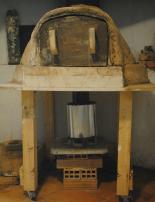
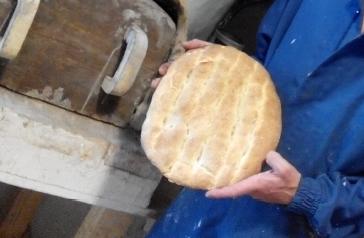
It is is a rocket style stove that uses wood to heat a cast iron griddle and an oven. It is an efficient stove that also includes an chimney, and the option to build it into an attractive and functional kitchen island. They also have an option that heats water (for washing or bathing).

For more information, and pictures, and to buy the stove, see their website:
http://www.ecofogao.com.br/

Erin Rasmussen

Muhammad Nurhuda from the Physics Department, Brawijaya University
in Malang, Indonesia

They have developed a various biomass stoves ( Kompor Biomass ) The fuels also vary from chopped woods/twigs, pellet, palm kernel shell, hazelnut kernel shell, corncob, etc..

And they have a nice collection of YouTube videos:

All stoves presented above are of TLUD types, but the combustion is improved by using pre-heating and counter-flow burning mechanism. The one intended for palm kernel shell utilizes diffused-combustion mechanism, in addition to pre-heating and counter flow mechanism.

The latest one

http://www.youtube.com/watch?v=b70z9-0nK6E

is devoted for institutional cook stove or small restaurants.

Very recently, we have also developed a new rocket stove. The combustion in this new rocket stove is improved by introducing counter-flow burning mechanism.

http://www.youtube.com/watch?v=kID0YL6TyqA

Erin Rasmussen

Umang Maheshwari, Greenway Grameen Infra

The Greenway Smart Stove is an insulated metal stove, that appears to be a rocket style design with bakalite handles and a metal pot rest and fuel rest. You can see more details in the Greenway Smart Stove flyer.

This stove is marketed as an improvement over the mud Chulha, which is familiar in India.

Erin Rasmussen

Flip and John Anderson, January, 2012

Erin Rasmussen

Andrew C. Parker, October 2011

Lion Cub Stove
A variation on Larry Winiarski's 16 Brick Stove
and Crispin Pemberton-Pigott's Lion Stove

"I had been waiting all Summer to use my brother's StoveTek
stove to do some experiments. While searching a reference

Erin Rasmussen

Practical Action, Kenya

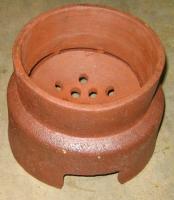
The Upesi stove, also known as the Maendeleo has been successful in Kenya. It has two parts, a simple pottery cylinder with pot rests (known as the liner) that is built into a mud surround in the kitchen. Fuel is fed into the fire through an opening in the front of the stove, and it has no chimney, but it produces much less smoke than an open fire.

Zakky

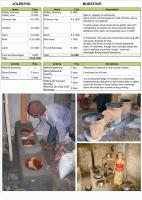
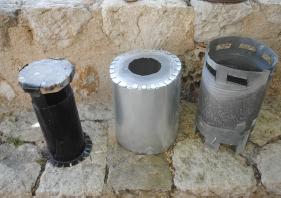
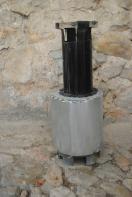
Jolentho in javanese (a local language in Indonesia) means rounded and bulky, so Jolentho Stove means bulky and rounded stove. We gave it the name because the stove liner is made of round and bulky potteries. Every part of the liner is made from pottery, including the grate.

The liner is divided into 8 parts to simplify production and tranportation. To make a liner, one needs to have pottery making skill. For simplicity, the liner is produced by a professional pottery maker. The users only need to buy, install and cast a sand-cement mixture surround the liner. Although cement are not ressistant to heat (easily crumbles), pottery liner provide protection so that cement can last longer. Properly made, the stove will last for 10 years.

The stove has 3 potholes and a chimney to suit the needs of palm sugar producers in Indonesia. The technology is simple: fuelwood burns above grate. Grate provide air suppy and dispose ash. The enclosed combustion chamber provides improved combustion quality. After heating the pot in hole #1 rom beneath, hot smoke is channeled to pothole #2 and #3. There are baffles in pothole #2 and #3 to maximize heat transfer. Finally, the smoke exits through chimney. Chimney also provide draft that boosts combustion.
The innovations we offer are cost and time efficiency and simplicity in stove making, and. It only takes 1 men, 2 hours and 19.25 USD to make a Jolentho Stove and the stove is ready to use within 3 days. This is much more simpler, compared to a mud stove, which requires 4 men, 16 USD and 3 days only to make mud stove and additionally 17 days to get mud stove ready to cook. By all means, the Jolentho is much more favorable.

Erin Rasmussen

Crispin Pemberton‐Pigott October, 2008
Sustainable Energy Technology and Research Centre University of Johannesbrg 
Programme for Basic Energy Conservation GTZ/ProBEC a SADC Regional Project 

See the attached pdf: CERAMIC DEVELOPMENT FOR DOMESTIC STOVES 

Also take a look at Crispin's very good ceramic stove image galleries.

It is intended that this brief report describe in an accessible manner the results of some basic research into the performance of ceramic materials suitable for use to make modern, low‐cost improved charcoal stoves. The 
theatre of investigation is the area around Maputo, Moçambique. 

 The information and ideas are assembled from a large number of tests and reports. If studied carefully an understanding can be gained of the 
principle ingredients found in typical clays. It is hoped enough can also
 be learned about what the tests show so as to interest the ‘stover’ in a 
deeper study of this vast subject.  

Some reasons why clay stoves and stove components typically have such a 
short life are described and to a certain extent, what can be done about 
it.   

There is a great deal of material available on how to find, identify and 
process clays such as pottery books and the internet. It is not repeated 
here.  Unfortunately very little of the material available is geared to 
the design of low cost ceramics stoves which have problems not encountered
 in many industrial applications with far higher temperatures.  

Ceramics are complex mixtures of many minerals so it is not possible to 
give comprehensive explanations in such a brief text, however the novice 
reader should learn enough to be able to deal with a laboratory and 
understand some common terminology and the test results.  There have been
 many technological advances in recent years making accessible tests and 
analyses that were previously unaffordable to the ordinary potter.

Erin Rasmussen

Katene Kadji, is now manufacturing the Sewa Stove in Bamako, Mali.

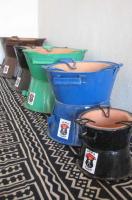
The new Sewa Improved Charcoal Stove has a ceramic liner, and a painted metal exterior, with jiko style pot rests that put the bottom of the pot low enough to improve heat transfer to the tobt

The carbon finance company E+Carbon is using carbon credits to help Katene Kadji to be able to offer the stoves for 2,500 CFA francs (5.33 USD) as opposed to the original retail price of 3,500 CFA (7.47 USD).

There is a current case study of the Sewa Stove at the Gold Standard web site:
http://www.cdmgoldstandard.org/fileadmin/editors/files/1_case_studies/Mali_Cookstoves_Case_Study.pdf

There's more in the Hedon site:
http://www.hedon.info/View+Article?itemId=10411

teddy

A charcoal oven in the kitchen of the Karen Blixen Camp, Maasai Mara.

They use it because it;
a) saves alot of money on buying LPG (fossil fuel)
b) cooks food really really well!

And it only uses a handfull of charcoal thanks to insulation and the ceramic liner!

to buy one please see

www.kenyacharcoal.blogspot.com

we also offer international shipping

Pages

Subscribe to Ceramic