Ray Menke
My wife and I made a short video showing how we make Pita Bread using a version of this stove design. Here is the link:
http://www.youtube.com/watch?v=JOuoE2KAbQI
Since I built the stove using the brightly colored helium balloon bottle for the outside cylinder it has gotten lots of use, and the colors have faded away. The interior and chimney have been replaced many times using my collection of coffee cans, grapefruit juice cans, and used stove pipe. The stainless steel kitchen pot cover has held up very well, and is still original, as well as the 2" steel pipe providing the primary air. As shown in the video, I have added a bit of forced air when I need more firepower. I mounted a 12 volt cpu fan from a junked computer (I think it was an old 386) in the bottom of an olive can, and used some heavy cardboard and some tape to make a funnel for the other end..which I stick into the primary air pipe.
(The same fan assembly can be used with my other stoves.) For normal water heating or cooking, the fan is not used, but making
32 pita breads requires over 90 minutes of controlled high level heat.
There is no smoke!
Correction: At 37 seconds, I refer to TLUD as top loaded up draft...Should be TOP LIT UP DRAFT. (The fuel is lit on top and burns downward.)
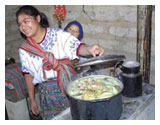
Showing the process of cooking Pita Bread on an Anderson TLUD Woodgas stove using two cast iron skillets. The fuel used was slices of mesquite bark (and wood) plus some larger chunks for maintaining the fire. The fire ran for well over 90 minutes without reloading. Thin strips of cardboard and folded junk mail were sprinkled with a few drops of alcohol to start the stove, and then both pans were pre-heated to the point where the Canola oil began to smoke (about 450 degrees F). During that 90 minute interval, small chunks of wood were used to maintain the fire. If the pans are not hot enough, the Pita Bread with not make a pocket. The steam trapped between the upper and lower surface cause the pocket to form. A burnt spot, or a hole will allow the steam to escape, and then you have a pizza crust!
It took me many attempts to get these pockets to form every time!
I have a two page .pdf document with the recipe and more details about the cooking process that can be downloaded from: http://woodworks-by-donna.com/Pita_Recipe.pdf
Correction: The fan is from a junked 386 computer CPU (I think?) It is not from a laptop computer. It runs on 12 volts. For normal use of the Anderson stove, the fan is not used, but the Pita Breads need a hotter fire.
Correction: At 37 seconds, I refer to TLUD as top loaded up draft...Should be TOP LIT UP DRAFT. (The fuel is lit on top and burns downward.)Air Jordan 1
Comments
Erin Rasmussen replied on Permalink
TLUD - Top Lit Updraught
Hi Ray
It does show that TLUD devices don't have the problems which people expect from a simple batch burn and I see you do add fuel from the top. The acronym actually stands for Top Lit Updraught Stove rather than the top loaded you commentary implies.
You say you use the char saved at the end of each run for cooking and gardening, any idea what proportions for each use and an estimate of production from you ~900 burns?
AJH
Erin Rasmussen replied on Permalink
Thanks for the comments.
Thanks for the comments. I will put a note in the video description area correcting the definition of TLUD.
I have been experimenting with about ten different wood gas stoves, and always dump the char into the bucket of water. Usually, I pour the liquid with the pieces of char into another bucket with a screen over the top to catch any pieces larger than about 1 cm. This second bucket with the fines and ashes gets tossed on the compost pile (six dump truck loads of chips mixed with cow manure). I save the larger pieces of char in large barrels and sacks in my barn for future use in some larger gasifiers (for ten hp engines) that I have been building on for some time.
Some of these chunks of char are used in cooking tasks where I want to simmer rather than boil the food.
However, since I have a good supply of hardwood (Mesquite) I probably use less than 1% of my char for cooking. Perhaps 25% ends up in the compost pile(s), and the remainder is stored in the barrels and sacks.
(estimated half a dozen 55 gallon (200 liter) barrels.) Last year, I built my version of the Anila stove using a 20# propane bottle. I guess it might be called a retort! It makes large amounts of beautiful charcoal from larger hunks of hardwood, while burning the pyrolytic gas under a very large pot or pressure cooker. My goal with this retort was to make high grade charcoal while making complete use of the flame for cooking, and producing no visible smoke. It uses a ten dollar ceiling fan speed control to vary the amount of forced air.
It works very well, but has too much ¨firepower¨ for normal cooking for two old retired people. (It will work well to reduce large amounts of cooked tomatoes into tomato paste.) I keep this high grade charcoal separate from the finer char produced by the cook stoves.
My Woodgas Campstove XL gets used about 60% of the time because I have a pot shroud that fits around the stove and the pot that makes it very efficient, especially when there is wind. I don´t get much char from this stove because I use it for things like rice and beans that need longer cooking times, with low heat toward the end. I have hardwired an old waterproof flashlight equipped with two D cells into the fan, and I use the flashlight switch to run the fan. (After several hundred uses, the factory installed connector got so loose the fan did not run all the time.) I let the fan run until the stove completely cools down, after dumping the char and ash into the bucket.
I am saving the char and charcoal because it is used in the starting of engine grade gasifiers. It can also be used in the gas filtering stages. Also, once I have converted the wood into char, the sub-tropical bugs stop digesting it...
As you probably saw on the evening news, there are many large wildfires destroying houses and vast amounts of rangeland here in Texas. All open fires are banned, with large fines and the possibility of two years jail time for violators. So, for the time being, I have shut down my outdoor kitchen...waiting (with my cows) for rain (and grass).
Ray
Erin Rasmussen replied on Permalink
You have substantial practical experience with TLUD gasifier sto
Dear Ray and all,
You have substantial practical experience with TLUD gasifier stoves, AND it is in the USA/developed world. Highly unusual, and so we appreciate your telling us your experiences.
Have you been sun-drying your saved charcoal before storage? How much time needed for drying.
...
This topic is important to Stoves Listserv because when the stove produces the fuel (charcoal) that can give CLEAN (minimal filtering) gases for running gensets and pumps, then remote villages could get critical electricity because of shifting their type of cookstove.
Thanks for your fine efforts!!!!!!
Paul
--
Paul S. Anderson, PhD
Known to some as: Dr. TLUD Doc Professor
Phone (USA): 309-452-7072 SKYPE: paultlud Email: psanders@ilstu.edu
http://drtlud.com/category/tlud-projects/